
Criminal Cases in the Washtenaw County Courts
Washtenaw County criminal cases do not all stay in one court. District courts hear misdemeanors punishable by up to one year, along with traffic matters and the opening stages of felonies. The countywide 14A District Court has locations in Ann Arbor, Ypsilanti, Chelsea, and Saline. The 14B District Court serves Ypsilanti Township, while Ann Arbor runs the separate 15th District Court. The county's official department directory routes users to these local court systems. Those courts keep their own criminal dockets. The event location therefore matters before any name search begins.
A felony starts in district court with a complaint, arraignment, bond review, probable-cause conference, and preliminary examination or waiver. Once the case is bound over, the 22nd Judicial Circuit Court handles the information, motions, plea or trial, sentence, and later proceedings. The Civil/Criminal Division at 101 E. Huron Street in Ann Arbor is the custodian of that circuit file. One prosecution can have a district number and a later circuit number, so checking only one file can hide half the record.
Three Washtenaw Criminal Docket Systems
The quickest routing rule is geographic. Ann Arbor city matters commonly begin in the 15th District Court. Ypsilanti Township matters route through 14B. Other county locations use the assigned 14A docket. The county's court-records hub links case lookup, calendars, warrant review, payments, and copy-request options for 14A users.
The hub is a routing page, not a complete case file. Its links point toward the right court service, and each clerk remains responsible for that court's records. The official Washtenaw court-record links show how these local choices fit together.
The linked county interface can be seen in this record-access view.
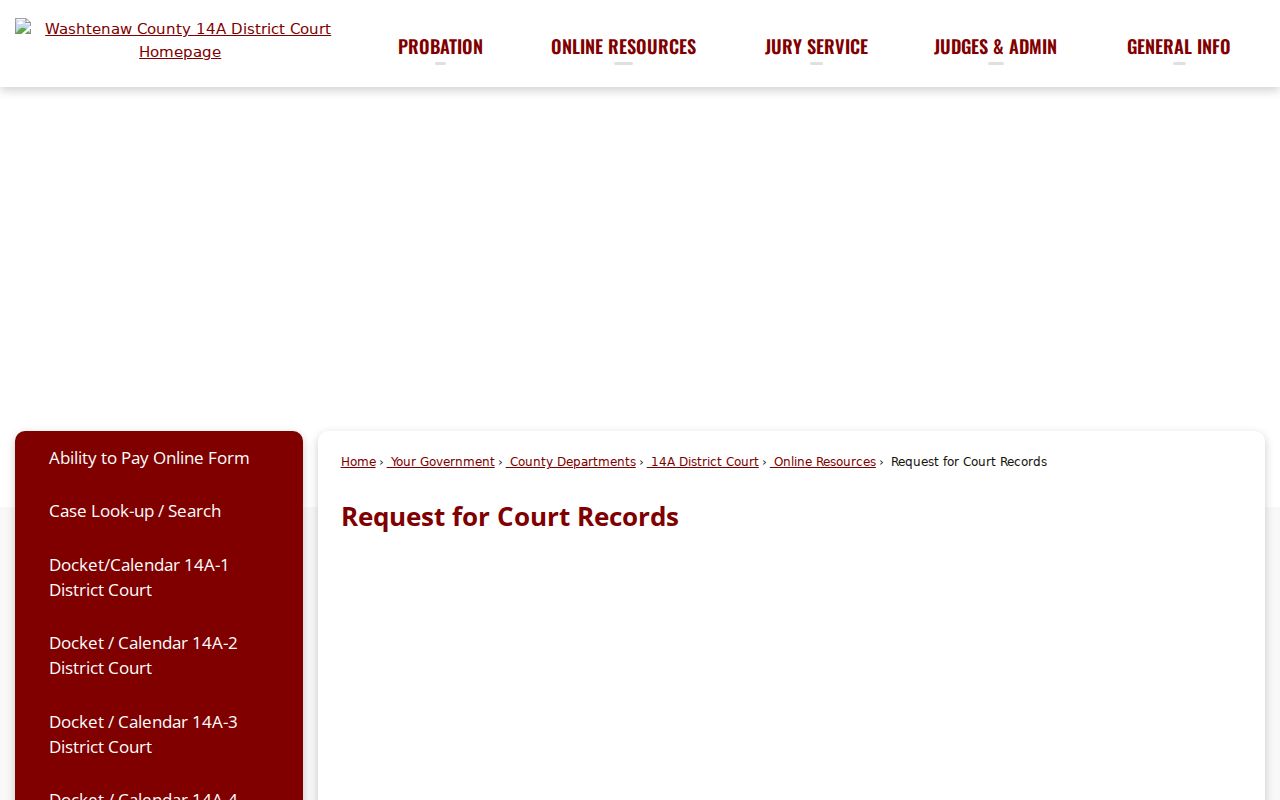
The image underscores why a searcher must choose the correct district or circuit route before asking for a document.
How to Search Case Records
Start with MiCOURT Case Search, accept its terms, and use the court and party controls to narrow the results. MiCOURT warns about its seven-year search filter and about attempt charges displayed under MCL 750.92. A missing result is not proof that no Washtenaw County criminal case existed. Older files, nonpublic matters, name variations, and recent filings can require clerk help.
- Identify the event location and choose 14A, 14B, 15th District, or 22nd Circuit.
- Search the party name, then repeat with the case number when known.
- Review each charge row and distinguish the filed charge from an arrest allegation.
- Read the register of actions in date order and locate the final judgment or dismissal.
- Ask the correct clerk for a plain or certified copy of the exact document needed.
| Field Label | Type | Required | Notes |
|---|---|---|---|
| Court | Select | Yes | Choose the Washtenaw district or circuit court. |
| Last name | Text | For name search | Use the legal surname and try known variants. |
| First name | Text | Recommended | Narrows people with the same surname. |
| Case number | Text | No | Most direct route when the full number is known. |
| Date range | Date/filter | No | Read the seven-year limitation before relying on it. |
The MiCOURT source provides the search interface shown here.
Its online summary is useful for leads, but the originating Washtenaw County clerk controls the official file and certified copies.
Washtenaw Felony Case Number Changes
A bind-over is a transfer, not a conviction. After a probable-cause finding or waiver, a felony moves from district court to 22nd Circuit Court and receives a circuit case number. The district file remains relevant because it records the complaint, first arraignment, bond, conference, and preliminary examination. The circuit file then shows the information, later motions, plea or trial, sentence, and post-judgment events.
This split explains a common false negative. A reader may open the district docket, see “closed” or “bound over,” and assume the prosecution ended. “Closed” can be an administrative status. Searching the circuit court under the same party name and then matching dates and charge facts supplies the later outcome.
Note: A Washtenaw County bind-over proves only that the felony advanced to circuit court, not that the defendant was found guilty.
What the Case File Shows
A useful Washtenaw County criminal case file is more than the results screen. The complaint states the initial sworn accusation. For a circuit felony, the information states the charge carried into that court. The register of actions is a dated event list, while the plea, order of dismissal, judgment of sentence, and probation order answer distinct outcome questions. Request the named document instead of asking a clerk for “everything,” especially when copies or certification may carry a fee.
| Case Number & Court | Identifies the docket and the Washtenaw court that owns it. |
|---|---|
| Charging Document | Complaint in the opening court; information for a bound-over circuit felony. |
| Register of Actions | Chronological entries for filings, hearings, orders, and status changes. |
| Hearing Dates | Scheduled and completed arraignments, conferences, examinations, motions, plea, or trial. |
| Disposition & Judgment | Charge-level result such as dismissal, acquittal, plea, or verdict. |
| Sentence & Conditions | Custody, probation, restitution, costs, and other terms ordered by the judge. |
Protected identifiers, victim and minor information, medical data, and other nonpublic fields are redacted or withheld. A public docket should not be read as a full investigative report.
Read Washtenaw Criminal Case Outcomes
Disposition words have precise effects. “Dismissed” means that charge ended without a conviction. “Acquitted” follows a not-guilty decision. “Guilty” may come from a plea or verdict. A deferred status postpones the final result while statutory terms are completed. None of those terms should be inferred from a generic “closed” label.
- Register of actions
- The court's dated list of filings, hearings, and orders.
- Bind-over
- The transfer of a felony from district court to circuit court after waiver or a probable-cause finding.
- Disposition
- The result of a particular charge, such as conviction, dismissal, or acquittal.
- Set aside
- Michigan relief that makes an eligible conviction nonpublic for ordinary access.
Read every charge row because one count may be dismissed while another produces a conviction. Then confirm the judgment. Booking data and ICHAT can still differ because those systems serve other purposes and update through separate reporting paths.
Stages of a Criminal Case
A Washtenaw County felony usually begins with the district-court complaint and arraignment. Michigan procedure generally places the probable-cause conference seven to fourteen days after arraignment, while the preliminary examination is ordinarily within twenty-one days unless waived or adjourned. A circuit case follows bind-over. Discovery, motions, negotiations, trial preparation, judgment, and sentence then create new docket entries.
Case flow: Charges Filed › Arraignment › Pretrial › Plea or Trial › Disposition › Sentencing
Later Washtenaw County criminal records can include probation review, a violation hearing, appeal activity, or a set-aside order. Specialized programs and county corrections options such as Recovery Court, 14A Sobriety Court, and Specialized Alternative to Sentencing Support may also produce review dates and conditions.
Washtenaw eTix Criminal Case Clues
Michigan's official eTix ticket and case search is another narrow route. It offers a Washtenaw court selector and ticket-oriented fields. It can help when a payable matter or ticket reference is known, but it does not replace a full district or circuit criminal docket review.
The state eTix screen shows the court and ticket controls used for that focused search.
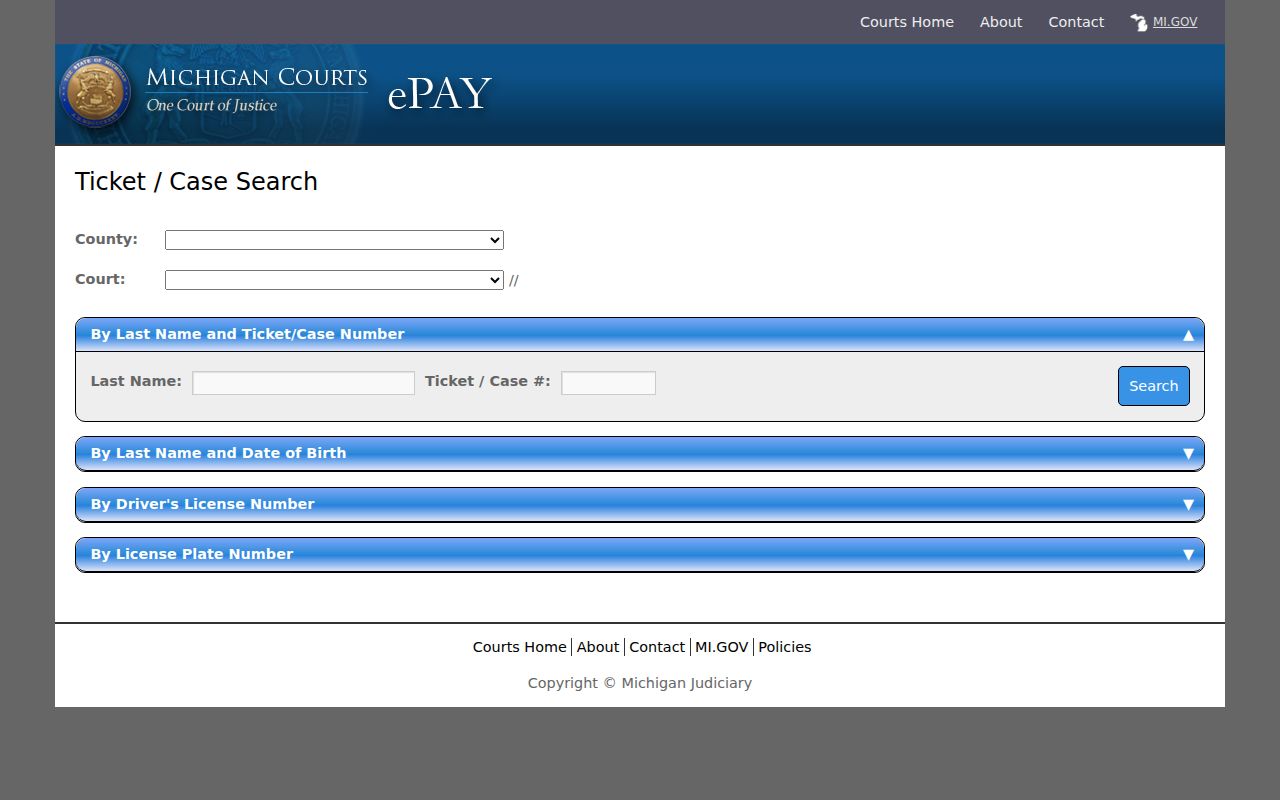
Use any result to identify the case, then return to MiCOURT or the Washtenaw clerk for the register of actions and filed documents.
Request Older Washtenaw Court Records
When an online result is absent or too thin, contact the court that owns the file. Phone staff can explain search mechanics and copy procedures, but they should not be asked to research a broad criminal history or interpret legal effect. Provide the full name, case number if known, approximate year, and exact document. Useful choices include the complaint, information, register of actions, judgment of sentence, probation order, or dismissal order.
The 22nd Circuit Court Civil/Criminal Division is at 101 E. Huron Street, Ann Arbor, MI 48104, with general Trial Court contact at 734-222-3001. The four 14A locations, 14B, and 15th District each maintain their own counters. Plain copies and certified copies serve different needs, and current fees should be confirmed with the clerk because no stable countywide amount was documented.
Access & Restrictions
Michigan Court Rule 8.119 makes court records presumptively accessible under court control, subject to nonpublic categories and redaction. Judicial files are requested from the clerk under court-record rules, not through an ordinary executive-agency FOIA demand. Juvenile proceedings, victim or minor identifiers, Social Security and financial-account numbers, and records restricted by statute or order do not appear like an ordinary adult criminal file.
The Michigan Freedom of Information Act remains relevant to police and sheriff records, while MCL 28.243 governs state criminal-history dissemination. Those channels do not turn the clerk's case file into an agency report. If a Washtenaw County criminal court record is missing online, ask the owning clerk whether it is older, recently filed, sealed, redacted, or otherwise nonpublic.
Note: Online omission is not proof that a Washtenaw County criminal case never existed; the court clerk is the authoritative access point.