
How to Check Criminal History in Ann Arbor
Begin by deciding what kind of event you need to confirm. Ann Arbor Police Department records can document a city incident, an arrest made by AAPD, or a qualifying local history certificate. The 15th District Court supplies the public case trail for Ann Arbor misdemeanors, traffic matters, and the first steps of a felony. The Washtenaw County Sheriff holds county-jail booking and release material. Michigan State Police maintains ICHAT, the statewide public criminal-history product. None of those channels is a substitute for all the others.
- Ask AAPD Police Records whether the event is eligible for a direct report copy or must go through Police FOIA.
- Identify the report number, date, location, involved person, and exact report or media you need.
- Search the 15th District Court route in MiCOURT or contact its clerk for a docket or copy.
- Use the Washtenaw arrest-history channels for county booking, custody, and release information.
- Use ICHAT for public reportable Michigan history, then verify any result with the originating court.
This order preserves the difference between what police reported, what the jail recorded at intake, and what a court ultimately decided. Search both district and circuit files when a felony was bound over.
Ann Arbor Criminal Records on Huron
Two downtown Huron Street addresses create a common records mistake. The Ann Arbor Justice Center at 301 E. Huron Street contains AAPD Police Records on the second floor and the 15th District Court. The Washtenaw County Courthouse at 101 E. Huron Street holds the 22nd Circuit Court Civil/Criminal Division. A person seeking a city police report or district case should not assume the county courthouse counter keeps it.
The split matters most in felony research. The 15th District file follows arraignment, bond, the probable-cause conference, and the preliminary examination or waiver. If the matter is bound over, a new circuit file continues the case at 101 E. Huron. “Bound over” means the case moved forward after a probable-cause finding or waiver; it does not mean the person was convicted.
Bring the case number and name the document when seeking a copy. The register of actions supplies the event timeline, while a complaint, information, dismissal order, or judgment answers a narrower question. Downtown court security screens visitors, and parking is not assured at either building. Calling the correct clerk before traveling can confirm hours, copy procedures, and whether the requested file remains available at the counter.
The Ann Arbor Police Department
AAPD Police Records is at 301 E. Huron Street, second floor, Ann Arbor, MI 48104. Its public counter hours are Monday through Friday, 9 a.m. to 4 p.m. The records line is 734-794-6954, fax is 734-994-9928, and email is a2policerecords@a2gov.org. Staff recommend calling or emailing first because downtown parking and building security can add time to a walk-in visit.
The unit handles police report access, city-only criminal-history certificates, certain court-ordered fingerprints, and sex-offender registration. AAPD does not become the custodian of a University of Michigan DPSS incident merely because it occurred near downtown. Identify the responding agency before requesting a record.
The official Ann Arbor Police Department page shows the Justice Center context for city police services.
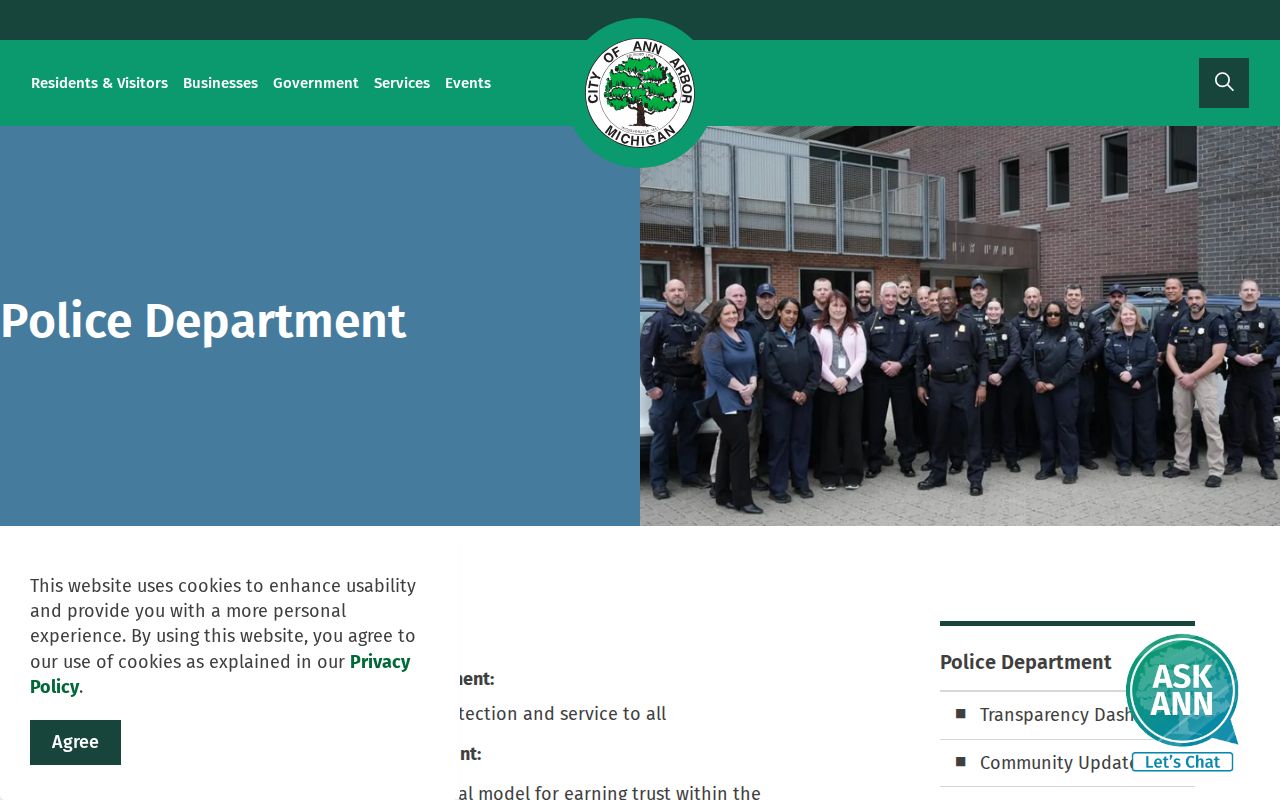
That shared building explains why police and district-court counters are close, though their records remain separate.
Ann Arbor Police Report Choices
Some involved people can obtain a crash report online or in person for $5 with photo identification. A mail request needs an ID copy, incident number, payment, and, when made within 30 days of the crash, the special form required by AAPD. Qualifying reports involving only the requester, with no arrest or other person, can also cost $5. The city gives harassing calls, vandalism, a private-property crash, theft, and lost property as examples.
Other police material goes through Police FOIA. That route is appropriate for reports requiring review, body-camera footage, 911 audio, photos, supplements, or records involving other people. Describe the precise item instead of asking broadly for “everything.” A focused request gives the coordinator a usable incident number, date and time, location, names, and requested format.
The AAPD Police Records source sets out the available report products, counter details, and request routes.
Those separate products help a requester avoid an unnecessary FOIA filing when a direct copy is available.
Arrests and Bookings in Ann Arbor
AAPD creates the incident or arrest narrative when its officers make an arrest. The person may then be booked into the Washtenaw County Jail at 2201 Hogback Road. Housing someone there does not turn the city report into a Sheriff report. Ask AAPD for the narrative and the Sheriff for a booking sheet, intake charges, booking and release times, bond data, or a booking image if it is lawfully available.
A booking charge describes what was entered at intake. The prosecutor may authorize a different charge, amend it, or decline it. The court docket then records filed charges and dispositions. For that reason, neither a police report nor a booking entry proves conviction. The county does not currently provide a stable, indexed official jail-roster page, so use the Sheriff, VINE, or a focused records request rather than relying on an unofficial people-search page.
Ann Arbor University Criminal Records
The University of Michigan Department of Public Safety and Security has its own police and records channel. An incident on central campus may belong to U-M DPSS, while an event on a nearby city street may belong to AAPD. The city name alone does not settle custody. Check the responding officer’s agency, the report number, and the exact incident address before asking AAPD for a copy.
A campus police report and a city police report can still lead into the same local court system when charges are filed. Request the narrative from the agency that created it, then use the court case number to follow public prosecution events. If a county-jail booking occurred, obtain that separate record from the Sheriff. This agency-first method is especially useful in Ann Arbor because the university’s daily population and property footprint extend well beyond a single compact block.
Ann Arbor Local History Certificate
AAPD offers a $10 notarized certificate stating whether the subject has been arrested by Ann Arbor Police. It is self-only and usually takes 10 to 30 minutes in person. Adoption requests can take up to five business days. Mail requests need the completed, notarized form. The form asks for the subject’s legal name, other names, date of birth, current or former Ann Arbor address, contact information, and payment instructions.
The certificate is not ICHAT. It does not search every Washtenaw agency or statewide Michigan history, and it does not turn an AAPD arrest into a court disposition. Use it when the narrow question concerns your own contact with Ann Arbor Police. Use the county criminal-history routes when the question spans other agencies or jurisdictions.
A certificate reporting no AAPD arrest cannot rule out a U-M DPSS, Sheriff, Michigan State Police, or other agency record. It also cannot supply a court’s final judgment. Read the certificate as a city-police product with a defined custodian and scope.
Ann Arbor Municipal Court Records
Ann Arbor operates the 15th District Court, rather than a limited ordinance-only municipal court. It handles city misdemeanors, traffic and civil infractions, and the district stages of felony cases. Search through the participating MiCOURT route or contact the clerk at 301 E. Huron Street. Online entries are informational; a plain or certified copy from the court is the better source when the precise wording of an order matters.
| Court Name | 15th District Court, Ann Arbor Justice Center, 301 E. Huron Street; 734-794-6750 |
|---|---|
| Case Types Heard | Misdemeanors, traffic and civil infractions, and felony preliminary stages arising in Ann Arbor |
| Case Lookup Channel | MiCOURT participating-court search, court clerk counter, or written records request |
| What the Docket Shows | Case number, parties, public charges, events, hearings, disposition, and sentence entries when public |
| Copies & Fees | Request the exact document and ask the clerk for current plain-copy or certification charges |
Ann Arbor Police FOIA Routes
Police FOIA requests may be filed through the city database, by email, by mail or in person with the Police Records FOIA Coordinator, or by fax. The request must sufficiently describe an existing record and give the requester’s name, address, and contact details. Ask for a report, supplement, dispatch record, audio, video, or image by name. The city may charge permitted search, review, separation, duplication, and delivery costs.
The Ann Arbor records-request source explains police request methods, fee procedures, and appeal paths.
The multiple filing methods still lead to the same task: describe the record well enough for the correct city custodian to locate it.
Where Ann Arbor Records End Up
An AAPD report remains a city record. If charges are authorized, the 15th District Court creates the first court file. A felony that clears the district stage moves to the 22nd Circuit Court, while reportable charge and disposition data flows to the Michigan State Police Criminal Justice Information Center. The county jail separately retains booking and custody records.
Record flow: Ann Arbor Police Department › Washtenaw County Courts › Michigan State Police Criminal Justice Information Center
For a very recent event, start with AAPD and the court rather than expecting ICHAT to show a finished outcome. For an older case, compare the district docket, any circuit continuation, and ICHAT. ICHAT excludes warrants, suppressed records, federal and out-of-state matters, traffic records, juvenile records, and some local minor misdemeanors.
Ann Arbor Court-Ordered Fingerprints
AAPD’s fingerprint service is unusually narrow. It handles only fingerprints ordered by the 15th District Court, on Wednesdays from 8 to 11:30 a.m. and 1 to 3 p.m. at the second-floor front desk. Bring the fingerprint order, felony or misdemeanor complaint, and identification. Appointment requests go to aapdfingerprinting@a2gov.org.
Other fingerprint needs go to the Washtenaw County Sheriff or a Michigan-authorized Live Scan location. A fingerprint transaction can support an identity-verified official process when law permits it. It is different from a name-based ICHAT search and from AAPD’s local certificate.
Public Access Rules
Michigan FOIA governs records held by AAPD and other city executive offices. It favors access to nonexempt public records but permits redaction or withholding for privacy, active investigations, confidential sources, protected personal data, and other listed grounds. Judicial files follow Michigan Court Rule 8.119, not ordinary agency FOIA. Ask the court clerk for court records and the city coordinator for police records.
A missing online entry does not prove that no record exists. Juvenile matters, victim and minor identifiers, LEIN information, sealed or set-aside material, and other protected records may be withheld or absent from public systems.
Key Statutes:
Michigan Freedom of Information Act, MCL 15.231 et seq. - Establishes access to nonexempt records held by Michigan public bodies.
Michigan FOIA exemptions, MCL 15.243 - Allows specific privacy, law-enforcement, and protected-record redactions or denials.
Michigan Court Rule 8.119 - Presumes court-file access while preserving nonpublic categories and court control.